RateRadar
FedECBFed vs ECBScenariosMethodologyGlossaryBrokersAboutiPhone app

Track Fed and ECB odds on your iPhone

Free, no account, no in-app purchases. Requires iOS 17 or later.

Download on the App Store

Live tracking

  • Next Fed meeting
  • Next ECB meeting
  • Fed vs ECB
  • Rate scenarios

iPhone app

  • Fed rate tracker app
  • Rate cut alerts
  • CME FedWatch alternative

Reference

  • Methodology
  • Glossary
  • About
  • Privacy

Probabilities are computed in house from 30 Day Fed Funds Futures and euro short-term rate data, then refreshed twice per business day. They describe what the market is pricing, not what a central bank will decide. RateRadar is informational and is not financial advice.

RateRadar in the Law of Large app collection

Home / Rate cut alerts
Notifications

Fed rate cut alerts on iPhone

Checking the odds every morning is a chore. RateRadar reverses it: a reminder before each Fed and ECB decision, and a nudge when the odds of a cut move past a threshold you set.

Download on the App StoreFree. Both alert types on by default.

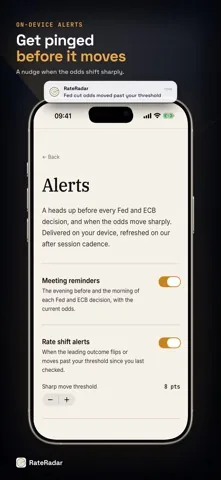
Alerts settings screen with meeting reminders and rate shift alerts, and a sharp move threshold set to 8 percentage points.
Two kinds
Meeting reminders

The evening before, and the morning of

Every scheduled Fed and ECB decision gets two reminders, and each one carries the current odds rather than just the date. You walk into the announcement knowing what was priced in going in.

Rate shift alerts

When the odds move past your line

Between refreshes the app compares the new leading outcome against the last one it saw. If the leader flips, or its probability moves by at least your threshold, you get one alert naming the meeting and the move.


The threshold

You decide what counts as news

The sharp move threshold is a number of percentage points, adjustable between 5 and 25, and it starts at 8. Set it low and you hear about most of the drift into a meeting. Set it high and you only hear when something has genuinely repriced. Either way, the alert fires at most once per meeting per refresh, and the app compares against the last snapshot it actually saw, so nothing is double counted.

Range
5 to 25 pts
Default
8 pts
Refresh cadence
2 per business day

Setting them up
  1. Install RateRadar and allow notifications when iOS asks.
  2. Open the Alerts screen. Meeting reminders and rate shift alerts are both already on.
  3. Move the sharp move threshold if 8 percentage points is too chatty or too quiet for you.
  4. Change your mind later in the app, or switch everything off in iOS Settings under Notifications.

FAQ

Alert questions

How do I get an alert when the Fed cuts rates?
Install RateRadar on iPhone and allow notifications. Meeting reminders and rate shift alerts are both on by default, so you get a heads-up the evening before and the morning of every Fed and ECB decision, and a separate alert whenever the odds move sharply between refreshes.
What counts as a sharp move?
Two things trigger a rate shift alert: the most likely outcome for a meeting changes, or the probability of the leading outcome moves by at least your threshold since the last snapshot the app saw. The threshold defaults to 8 percentage points and you can set it anywhere from 5 to 25.
Will it wake me up for every small wiggle?
No. The probabilities are recomputed twice per business day, not tick by tick, and a move only counts if it clears your threshold. On a quiet week you may hear nothing between the two meeting reminders.
Do I need an account for alerts?
No. There are no accounts in RateRadar. The alert preferences live on your device and the reminders are scheduled locally, so nothing about your settings leaves the phone.
Can I turn one kind off and keep the other?
Yes. Meeting reminders and rate shift alerts are separate toggles on the Alerts screen. Turning off notification permission in iOS Settings stops both.
Download on the App StoreFree on the App Store. iOS 17 or later.

Related: the app in detail, compared with CME FedWatch, the next FOMC meeting, and the next ECB meeting.

Alerts describe what the market is pricing. They are not a prediction of what a central bank will decide, and they are not financial advice.